
In essence to develop evidence-based solutions for global public health challenges by collaborating with governments, academic, medical, and community organizations around the world.
GAPCI will engage community health workers (CHWs), workplace health and safety workers (WHSWs), health professionals and other stakeholders to promote individual and community-based responses to occupational and environmental health issues.
GAPCI will recognize, respect, and rely on local knowledge and lived experiences –to build trust, to rely on the fifth wave in public health that requires shared responsibilities for healthier behavior, valuing and adopting healthy lifestyles.
Our firm belief in health as a human right and the right to science will be the guiding efforts of the center.
GAPCI believes in the empowerment of the community with the help of CHWs, WHSWS, and health professionals. The focus of the center is to develop and implement targeted evidence-based prevention strategies for the residents living in underserved areas. GAPCI will start small with initiatives in US urban and rural areas and worldwide including slums /shanty towns in Africa, Caribbean/Latin America, and Asia. As public health professionals at GAPCI, we always ought to start with what people already know and/or do share the life experience of those we want to work with and/or organize.
GAPCI serves under-served populations regarding public health challenges by working with community health workers, workplace health and safety workers, and global partners in primordial prevention, encouraging people to value their health more highly, helping them to make healthy choices more easily, reducing the ways in which unhealthy lifestyles are promoted, and recognizing that we all have a role in supporting others to adopt a healthy lifestyle.
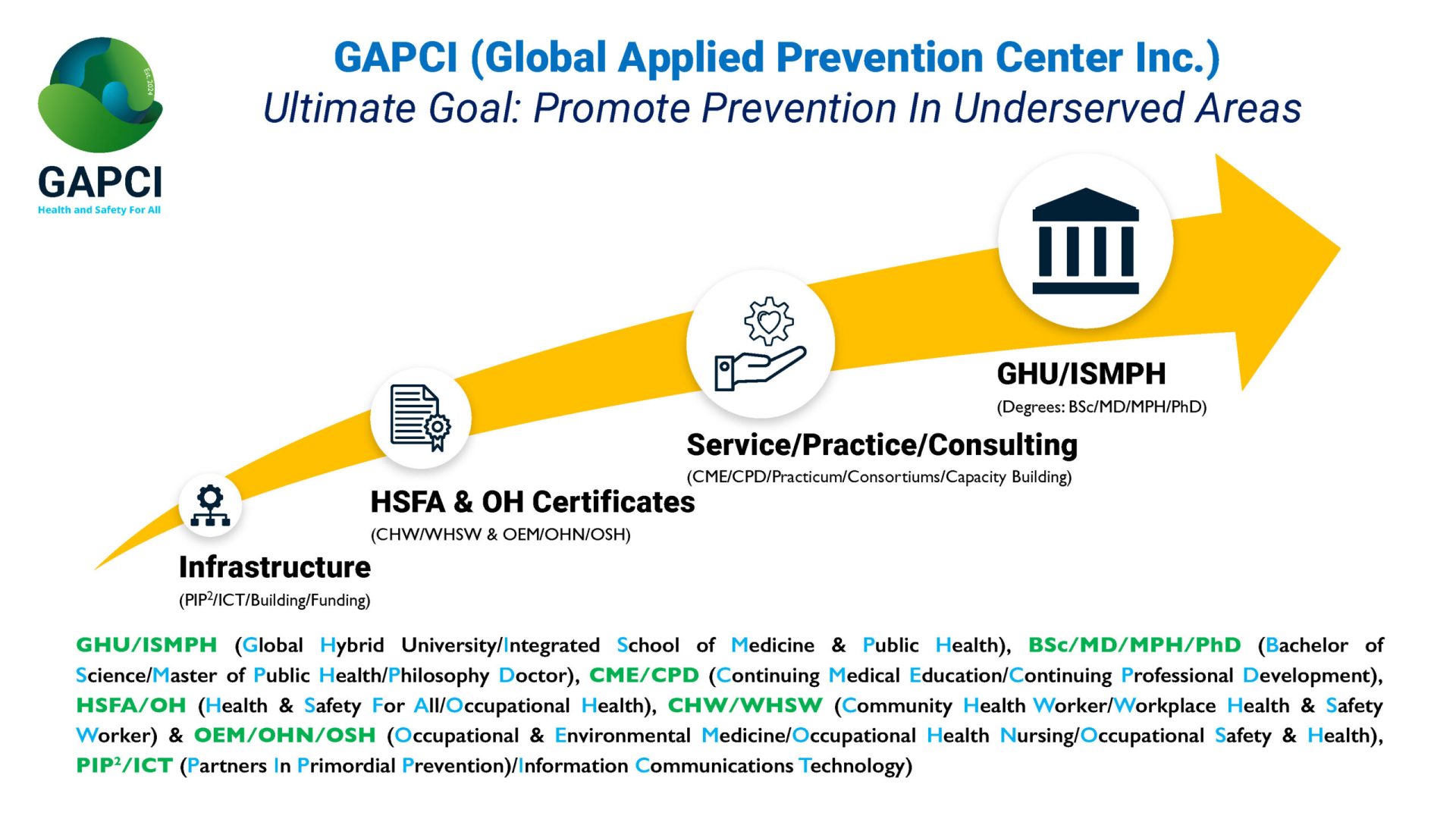
At GAPCI, our work is driven by specialized committees that ensure we remain at the forefront of global health advocacy, research, and education. These committees facilitate our mission to advance primordial prevention and worker protection.
| Committee | Strategic Focus |
|---|---|
| Executive & Strategy | Drives organizational vision, long-term planning, and ensures alignment with global health standards. |
| Fundraising & Finance | Secures sustainable resources and manages financial stewardship to support our global initiatives. |
| Education & Curriculum | Develops evidence-based training modules, capacity-building programs, and professional development resources. |
| Occupational Health & Community Outreach | Implements direct interventions, field research, and protective programs for vulnerable and underserved workers. |
| Global Partnerships & PIP² | Cultivates international alliances and advances our Primary Intervention, Prevention, and Policy (PIP²) framework. |

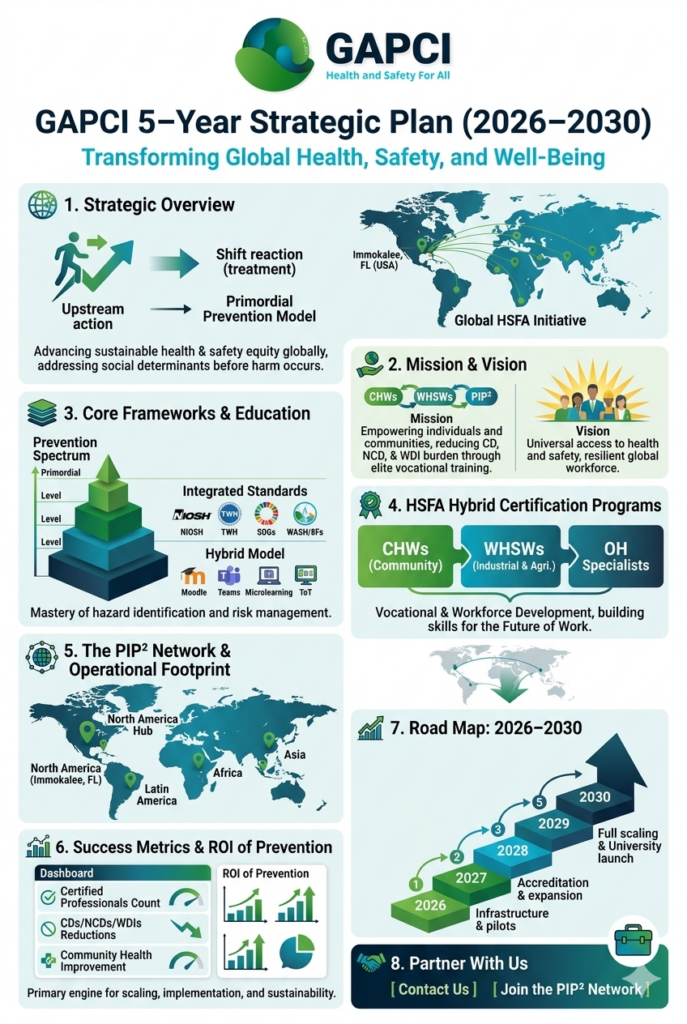
The Global Applied Prevention Center, Inc. (GAPCI) is a U.S.‑registered 501(c)(3) nonprofit organization leading a paradigm shift in health, safety, and well‑being. GAPCI is moving beyond reactive, treatment‑based and compliance‑driven systems toward a Primordial Prevention (Upstream Action) model – addressing root causes before disease, injury, or harm occur.
Our goal is to advance sustainable health and safety equity by addressing the social, environmental, and occupational determinants of health across diverse global populations and workforces. From Immokalee, Florida (USA) to the world, GAPCI leads the Health & Safety for All (HSFA) Initiative through Global North–Global South knowledge exchange, digital learning, and technology‑enabled collaboration.
The HSFA Initiative is a unified global movement bringing together GAPCI, Partners in Primordial Prevention (PIP²), Community Health Workers (CHWs), and Workplace Health & Safety Workers (WHSWs) to transform prevention systems at scale.
Our Mission
GAPCI is a global nonprofit organization dedicated to advancing health and safety for all by preventing and reducing the burden of Non‑Communicable Diseases (NCDs), Communicable Diseases (CDs), and Work‑related Diseases and Injuries (WDIs) in underserved communities and workplaces worldwide.
Through a collaborative network of CHWs, WHSWs, and PIP² partners, GAPCI empowers individuals and communities to take control of their health and well‑being, fostering a culture of prevention and promoting healthy lifestyles globally. Through the HSFA Initiative, GAPCI delivers elite vocational training and evidence‑based prevention strategies that translate science into action.
Our Vision
A world in which health and safety are universally accessible and equitable, where communities and workplaces thrive through prevention and the promotion of well‑being, and where locally empowered leaders and organizations drive lasting impact and policy change. GAPCI envisions a future defined by equitable health access and a safe, resilient global workforce.
GAPCI is governed by a Board composed of a President/CEO, Secretary, and Treasurer, supported by the following standing committees:
The Health & Safety for All (HSFA) Initiative is GAPCI’s primary vocational and workforce‑development arm. Low‑income and rapidly developing middle‑income countries face widening inequities marked by rising costs, limited access, and rapid population and economic growth. These trends demand a strategic re‑prioritization of health and development during economic transition.
HSFA responds by integrating economic development with health protection, breaking the persistent cost–access bottleneck through upstream, prevention‑first solutions.
HSFA Hybrid Certification Programs
Value Proposition
The Triple Threat: NCDs, CDs, and WDIs
GAPCI applies a rigorous, evidence‑based prevention architecture that includes:
GAPCI serves both the Global North and Global South, prioritizing high‑risk populations in:
GAPCI’s hybrid education model ensures mastery of hazard identification, risk management, and prevention leadership through:
The Partners in Primordial Prevention (PIP²) network is GAPCI’s primary engine for scaling, implementation, and sustainability:
PIP² is not only a service‑delivery platform – it is GAPCI’s most powerful impact and sustainability asset, demonstrating the ROI of Prevention, employer‑supported certification models, and hub‑adoption partnerships.
Revenue Strategy
A diversified model combining:
Key Performance Indicators
Strategic priorities include ESG, digitalization, climate change, workforce capability, human‑centered workplaces, OSH metrics, professional transformation, partnerships, and global impact.
Join GAPCI in securing the right to a safe and healthy life for all. Together, we can scale the Immokalee model to every continent and empower communities and workers to take control of their health using their innate capabilities.
Primordial prevention focuses on emergence of risk factors, such as unhealthy behaviors or environmental and/or occupational conditions, rather than just treating diseases that result from them.
Lead came at the forefront of this exposure when people discovered lead’s unique properties, such as its high density (heavy metal), malleability, and ability to resist corrosion.
1. Primordial Prevention: Preventing the source of lead contamination from entering the environment and from leaving the premise of the workplace while protecting the workers.
2. Primary Prevention: Preventing lead exposure in the population and in the workers.
3. Secondary Prevention: Early detection and intervention for individuals already exposed to lead.
4. Tertiary Prevention: Managing and reducing the effects of lead poisoning in individuals.
5. Quaternary Prevention: Avoid over-medicalization and unnecessary treatment.
o Miner – Jose, a smelter, worked for a lead smelting company. He used the personal protective equipment at work. He somehow didn’t always take a shower nor change clothes before heading home. So, he ended up bringing lead dust home to his family.
o Home – Also, his family of four lived in an old home that was built in 1950s in an old part of a large city. They had no idea that their home’s old paint and pipes were contaminating their air and water.
o Play and Exposure – His children played with toys and crawled on floors contaminated with lead dust from Jose’s clothes and shoes. They tried his clothes on from time to time. They played also in the front and backyard that had a lot of dust. While doing laundry, his wife was exposed to lead dust from Jose’s work clothes. Also, Jose’s own health was at risk due to extensive exposure to lead at work.
o Diagnosis – Jose’s children were diagnosed with developmental delays, learning disabilities, and behavioral problems due to exposure to lead. His wife had miscarriages and infertility issues. Jose developed kidney damage, high blood pressure, and memory loss.
o Correlation between environmental and biological assessments – The environmental assessment revealed high lead levels in the dust in the living room, bedrooms, the front and the backyard. There was a correlation between the environmental lead levels and blood lead levels from all the members of the family.
o Lesson – Take-home lead poisoning and lead poisoning from the inside and outside of an old home constitute real health risk for families. In this scenario, the family is confronted with 1) lead from the workplace and the clothes that the father took home and 2) lead in the home’s environment that came from old lead-based paint and lead-contaminated soil and dust from the city’s major streets (due to the legacy from the leaded gasoline).
o Prevention – Prevention is the only key, especially primordial prevention that would have prevented the source of lead contamination from entering the environment (if our society did not add lead in gasoline, paint, and other products) and from leaving the premise of the workplace while protecting the workers. Healthy diet that has a high content of calcium, iron and other essential minerals goes along of way to prevent lead poisoning.
o While in graduate school in Chicago in early 1990s, Prof Gasana was part of a team that collected samples of soil and dust along highways and major streets in Chicago, took them to the lab, and analyzed them for lead.
o In mid-1990s, Prof Gasana, his colleagues, his graduate students, and Community Health Workers (CHWs) that he hired received support to conduct a pilot study using funds he raised from a nonprofit organization (FAECLP – Florida Alliance to Eradicate Childhood Lead Poisoning, with the help of FIU (Florida International University) Sponsored Research Division.
o In the mid-2010s, he did consulting work for the World Bank in the Democratic Republic of Congo (DRC) that assessed the impact of mining on miners, surrounding populations, and the environment. The work uncovered heavy contamination of the environment by toxic heavy metals that included lead, mercury and others.
o He taught “Advanced Waterborne Diseases” to PhD students majoring in Water and Public Health in Ethiopia. The course emphasizes the crucial importance of WASH (Water Sanitation Hygiene) and the 8 Fs (1. Feces / 2. Fluids / 3. Fingers / 4. Flies
/ 5. Fields / 6. Floods / 7. Food / 8. Faces) of WASH barrier of waterborne disease transmission in preventing communicable diseases (especially diarrheal diseases).
o He conducted a two-week workshop of OSH (Occupational Safety and Health) for young Haitian entrepreneurs who were funded by USAID for their business of soap making, bakery, chicken farms, and others. GAPCI board member, Phil Hagan provided him with a lot of teaching materials form his OSH books he publishes under the National Safety Council.
o He then moved to Kuwait University (KU) where he served as founder/inaugural EOH (Environmental and Occupational Health) department chair and
MPH (Master of Public Health) program director and he replicated that Miami lead poisoning study in Kuwait.
o At KU, he taught Public Health Biology to non-health major MPH students at Kuwait University. This course is designed to assist students in public health in their understanding of the pathogenesis of various disease conditions (especially NCDs) and to identify critical points in the aging process at which such pathogenesis could either be prevented or interrupted (Primordial prevention that targets major modifiable risk factors is strongly recommended, especially when it focuses on the young people).
o All of this work led to the idea of establishing GAPCI (Global Applied Prevention Center Inc.).
o Prof Gasana strives to practice what he preaches using the 12 Ss
1. Serenity (Psychological Wellbeing/Stress Management/Mindfulness)
2. Sugar/Salt Limited Consumption
3. Smoking Cessation/Tobacco Control
4. Spirits/Alcohol Limited Consumption
5. Sleep (7-8 hours)
6. Sports/Physical Activity
7. Salad/Healthy Diet
8. Safety /Environmental Changes/Collective Efficacy
9. Shots/Vaccination / Regular Checkups/Health Education
10. Site-Specific Engagement (Community- & Workplace-Employee-Engagement)
11. Social Support /Collective Efficacy
12. Supplements when indicated by the lab test).
For #6. Sports, he does a 30+-minute whole body workout every morning (shine or rain). On November 27, 2023, Al Nahil Int’l Clinic in Kuwait did a physical examination and a body composition analysis and found out that Prof Gasana had a metabolic age of 57 years while his biological age was 67 years.
o Three of us as GAPCI board members strongly believe in the cost-effectiveness of primordial prevention to tackle NCDs and CDs. Prof Gasana (Janvier) met Phil (Hagan) while they were both serving on the Editorial Advisory Board of the National Safety Council (NSC) and they started brainstorming about GAPC. Chamberlain (Diala), Phil’s friend and classmate from the MPH program at George Washington University joined GAPCI as founding board member also after earning a PhD degree from Johns Hopkins University.
o Thus, we urge you all to join us at GAPCI as PIP2, donors, and/or volunteers. All work will be done using a hybrid format (online for training/teaching, research, and service by selected outstanding experts in health, public health, and primordial prevention and onsite for practicum, teaching, research, and service by PIP2 in the regional PIP2 hubs.


Founder and Chair
Professor Janvier Gasana is a distinguished, triple-qualified expert in Environmental and Occupational Health/Medicine (EOH/M) and Safety, holding an MD, MPH, and PhD.
He is the Founder and CEO of the Global Applied Prevention Center (GAPCI), where he advances healthspan, primordial prevention, and worker protection globally, with a strong focus on underserved populations and vulnerable workers.
His academic leadership includes single-handedly establishing the EOH Department at Florida International University and serving as Founding Chair of the EOH Department at Kuwait University.
Professor Gasana’s research spans childhood lead poisoning, asthma triggers, occupational and environmental determinants of non-communicable diseases, and prevention-oriented health behaviors. He has served as a consultant to major international organizations, including the World Health Organization (WHO), the World Bank, and USAID.
Most recently, through WHO, he supported the Qatar Ministry of Public Health by developing an Occupational and Environmental Medicine training syllabus for primary health care providers, using a Training-of-Trainers (ToT) model aligned with U.S. CDC principles.
Professor Gasana has also served as an external reviewer for the Bachelor of Occupational Health and Safety Program at Imam Abdulrahman Bin Faisal University (Saudi Arabia) and has developed internationally adopted training programs, including the Safety Data Sheet module for iHeed’s Diploma in Occupational Medicine. As a translational researcher, he developed expertise in establishing nonprofit organizations and community consortiums.
An active leader within ACOEM, ICOH, and Medichem, he is personally committed to healthy aging, having reduced his biological age by ten years through daily whole-body exercise. He received the 2025 UK Society of Occupational Medicine Special Mention for Outstanding Global Contributions and the PREVER 2025 National and International Honorable Mention Award (Spain, 2026) for advancing global occupational health and safety.

Secretary
Phil Hagan, JD, MBA, MPH, is a seasoned attorney and risk management consultant with 30 years of experience advising diverse industries globally, lecturing at top universities, and leading International Risk Management, LLC on projects across multiple countries.

Treasurer
Chamberlain Diala, PhD, MPH, is the Director of Technical Infectious Diseases and Health Systems at FHI 360 in Washington DC, with expertise in HIV mitigation, local capacity development, and community health workforce development, and is known for his leadership and cross-cultural skills in complex environments.

Advisory Technology (ICT)/ PIP2

Program and Research Evaluation

Marketing/ Communication and Funding
Policy/ Advocacy and Engagement
Ethics Quality Assurance and Audit
The Global Applied Prevention Center Inc (GAPCI) partners with governments, academia, and community organisations to promote public health and safety.